




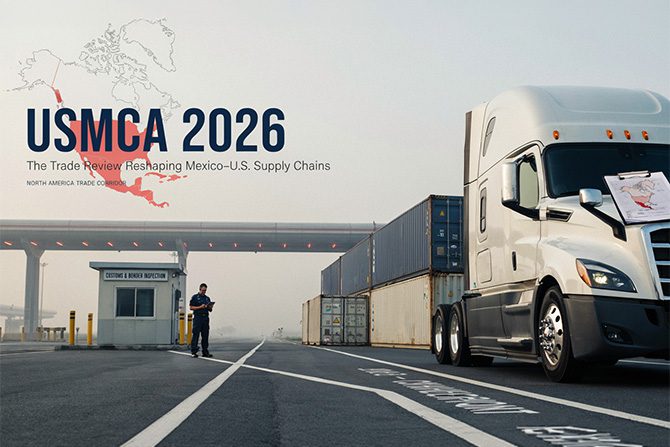
The USMCA 2026 Review has moved North American trade into a new period of negotiation and uncertainty.
On July 1, 2026, representatives from the United States, Mexico, and Canada completed the agreement’s first six-year joint review. The United States did not agree to renew the USMCA in its current form. That decision did not terminate the agreement or end preferential trade. The USMCA remains in force while the three countries continue working through the issues raised during the review.
For importers, exporters, manufacturers, and logistics teams, the immediate challenge is not whether cross-border trade will stop. It is whether current supply chains can withstand changes in rules of origin, tariff exposure, documentation requirements, supplier eligibility, and customs enforcement.
The United States and Mexico had already completed two bilateral negotiating rounds before the joint review. Discussions covered automotive rules of origin, steel and aluminum, economic security, industrial goods, agriculture, labor, the environment, and regulatory compatibility. A third bilateral round is scheduled for the week of July 20, 2026, in Mexico City.
The practical result is a longer period of policy uncertainty. Companies cannot assume that the rules used to design their supply chains will remain unchanged throughout the negotiation process.
This guide explains what happened during the USMCA 2026 Review, what nonrenewal means in practice, and how companies can protect Mexico–U.S. trade operations while negotiations continue.
Table of Contents
- USMCA 2026 Review: What Changed on July 1?
- What the USMCA Non-Renewal Actually Means
- Why the Review Matters for Mexico–U.S. Trade
- Industries Under the Greatest Pressure in 2026
- Cross-Border Compliance After the Review
- Why the Impact Is Uneven Across Companies
- The Most Common Planning Mistake
- Logistics as a Business Protection System
- The Role of the Logistics Partner in 2026
- FAQs
- Conclusion
USMCA 2026 Review: What Changed on July 1?
The USMCA entered into force on July 1, 2020, with a formal review mechanism built into the agreement.
Exactly six years later, representatives from the United States, Mexico, and Canada met virtually for the first joint review. The United States announced that it would not renew the agreement in its current form.
According to the official U.S. Trade Representative statement, the decision reflects unresolved concerns about the operation of the agreement. It does not mean that the USMCA has been canceled.
Before the July meeting, the United States and Mexico had already completed two bilateral negotiating rounds.
The discussions included:
- automotive rules of origin,
- steel and aluminum trade,
- economic security and non-market inputs,
- rules of origin for certain industrial goods,
- agriculture, labor, and environmental matters,
- regulatory compatibility under the agreement’s sectoral annexes.
The third U.S.–Mexico negotiating round is scheduled for the week of July 20, 2026, in Mexico City.
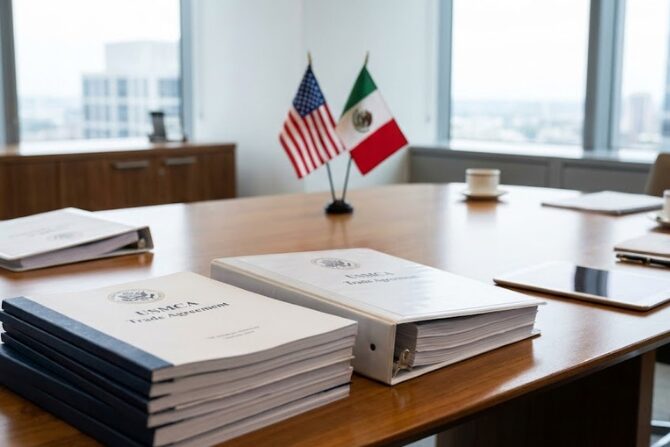
The USMCA 2026 Review opened a longer negotiation period for North American trade rules.
What the USMCA Non-Renewal Actually Means
The wording around the joint review can create the impression that the agreement has ended. It has not.
Under Article 34.7 of the USMCA, the countries could have confirmed an extension of the agreement for another 16-year term during the six-year review. Because all three parties did not confirm that extension, the agreement was not renewed at this stage.
In practical terms:
- the USMCA remains active,
- qualifying goods can still receive preferential tariff treatment,
- the countries may agree to extend the agreement during a later review,
- annual joint reviews will continue while an extension remains unresolved,
- the current agreement can remain in force through 2036 unless the parties extend it or another provision is used to withdraw from it.
The immediate risk is therefore not the sudden disappearance of the USMCA. It is the possibility that companies will make long-term sourcing and investment decisions while important rules remain under negotiation.
Preferential treatment also remains conditional. A shipment does not qualify simply because it moves between Mexico and the United States. The product must meet the applicable rule of origin, and the importer must be able to support the claim with accurate records.
Why the Review Matters for Mexico–U.S. Trade
The review has not reduced Mexico’s commercial importance to the United States.
According to U.S. Census Bureau data through May 2026, Mexico was the United States’ largest goods trading partner, with approximately $404.6 billion in total trade during the first five months of the year.
That position is supported by advantages that are difficult to replace:
- geographic proximity,
- integrated manufacturing networks,
- shorter transit times than most overseas supply chains,
- established cross-border transportation infrastructure,
- deep supplier relationships in strategic industries.
The scale of the relationship makes the outcome of the USMCA 2026 review especially important. Even a targeted change to a rule of origin, tariff treatment, or certification requirement can affect thousands of suppliers and shipments across an integrated production network.
For companies, the central question is not whether Mexico will remain a major trade partner. It is whether their current sourcing and logistics model will continue to qualify for the same benefits under any revised framework.
Industries Under the Greatest Pressure in 2026
The negotiations do not affect every sector in the same way. Some industries are receiving more attention because of their economic importance, regional content requirements, or dependence on materials from outside North America.
Automotive and auto parts
Automotive rules of origin remain one of the central issues in the 2026 discussions.
Manufacturers and suppliers should pay close attention to:
- regional value content calculations,
- the origin of steel, aluminum, and key components,
- supplier declarations and supporting records,
- changes that could affect vehicle or component eligibility.
For automotive supply chains, the risk is not limited to the finished vehicle. A change in the treatment of one component can affect sourcing decisions, landed cost, and production planning throughout the network.

Steel and aluminum
Steel and aluminum have been part of the bilateral negotiations from the beginning.
Companies using these materials should review not only the direct tariff treatment of the product being shipped but also the origin and documentation of the inputs used in manufacturing.
For many manufacturers, the relevant question is no longer simply where final assembly occurred. It is whether the complete production record can support the origin position being claimed.
Industrial goods and regulated sectors
The United States and Mexico have also discussed rules of origin for certain industrial goods and greater regulatory compatibility in sectors covered by the USMCA’s sectoral annexes.
These include areas such as:
- medical devices,
- pharmaceuticals,
- cosmetic products,
- other products subject to technical standards and sector-specific requirements.
For these industries, customs compliance and regulatory compliance must be managed together. A product may be correctly classified for tariff purposes and still face delays because of labeling, permits, certifications, or technical requirements.
Agriculture, labor, and environmental compliance
Agriculture, labor, and environmental matters also entered the 2026 negotiations.
These issues may appear separate from transportation, but they can directly affect supplier eligibility, inspections, sourcing decisions, and the ability to maintain uninterrupted trade.
The broader trend is that USMCA compliance is becoming more connected to how and where goods are produced, not only where they cross the border.
Cross-Border Compliance After the Review
The USMCA 2026 Review increases the importance of documentation and customs planning on both sides of the border.

Customs classification, origin, valuation, and documentation remain critical while USMCA negotiations continue.
For companies moving goods through Mexico, the areas requiring the closest attention include:
- tariff classification,
- country of origin,
- customs valuation,
- preferential treatment eligibility,
- supplier certificates and supporting records,
- permits, standards, and sector-specific documentation.
The origin of non-North American inputs deserves particular attention. The bilateral discussions have repeatedly addressed economic security and the role of third-country materials in regional supply chains.
A sourcing model that works under the current rules may become less competitive if future changes increase regional content requirements or restrict the treatment of certain inputs.
This is why customs planning should begin before a purchase order is issued or a shipment is booked. Once goods reach the border, classification, origin, and documentation problems are usually slower and more expensive to correct.
Why the Impact Is Uneven Across Companies
A common mistake is assuming that the review affects every business equally.
In practice, the impact depends on:
- industry exposure,
- supply chain structure,
- the origin of materials and components,
- USMCA compliance maturity,
- documentation quality,
- routing, and supplier flexibility.
A company with validated suppliers, complete origin records, and alternative transportation options can absorb change more effectively than one relying on a single route and incomplete documentation.
The difference often becomes visible only when a shipment is questioned, delayed, or assessed unexpected duties.
The Most Common Planning Mistake
The most dangerous assumption is that the current operating model can continue unchanged until the governments announce a final agreement.
That approach leaves companies exposed to:
- unexpected tariff costs,
- invalid preferential claims,
- border delays,
- supplier disruptions,
- last-minute routing and sourcing decisions.
The goal is not to predict every political outcome. It is to identify which parts of the supply chain would be affected first if a rule, tariff, or documentation standard changes.
Waiting for certainty is not a strategy. Building options before they are needed is important.
Logistics as a Business Protection System
After the USMCA 2026 review, logistics plays a broader role in Mexico–U.S. trade. It does not simply move goods; it helps protect production, margins, and customer commitments.
A resilient logistics strategy now includes:
- regular review of tariff and regulatory exposure,
- ongoing USMCA origin verification,
- alternative routes and border crossings,
- contingency planning for inspections and delays,
- coordination between procurement, customs, legal, finance, and operations.
This work is most effective when it happens before a purchase order is issued or a shipment is scheduled.
Logistics can no longer be treated as the final step in the transaction. It must be part of the sourcing and commercial decision from the beginning.

Resilient logistics planning is essential while the USMCA review process and bilateral negotiations continue.
The Role of the Logistics Partner in 2026
In this environment, the value of a logistics partner is not defined only by the lowest freight rate.
It is defined by the ability to help clients maintain control when regulations, capacity, documentation requirements, or border conditions change.
At The ILS Company, we go beyond transportation execution by helping clients to:
- review cross-border requirements before shipping,
- coordinate customs and transportation activities,
- develop flexible routing strategies,
- identify operational risks early,
- reduce avoidable delays and compliance errors.
The objective is not simply to react faster. It is to prevent predictable problems from becoming expensive disruptions.
FAQs
What happened during the USMCA 2026 Review?
The United States, Mexico, and Canada completed the first six-year joint review on July 1, 2026. The United States did not agree to renew the agreement in its current form, so negotiations and future reviews will continue.
Did the USMCA end on July 1, 2026?
No. The agreement was not renewed for a new 16-year term, but it remains in force. Qualifying trade can continue receiving USMCA benefits while the countries negotiate.
What happens after the USMCA is not renewed?
The three countries can continue negotiating and may agree to an extension later. Under Article 34.7, annual joint reviews continue while all parties have not confirmed an extension.
Can goods still receive duty-free treatment under the USMCA?
Yes, if the goods satisfy the applicable rules of origin and the preferential claim is supported by accurate certification and records. Not every shipment between Mexico and the United States automatically qualifies.
Which industries are receiving the most attention?
Automotive, steel, aluminum, industrial goods, agriculture, and regulated sectors are among the areas discussed during the 2026 negotiations.
What should importers and exporters review first?
Companies should begin with tariff classification, origin, supplier documentation, regional content requirements, customs valuation, and alternative routing options.
How does the USMCA 2026 Review affect logistics planning?
The review increases the need for stronger documentation, scenario planning, supplier validation, and coordination between logistics and compliance teams. Companies should prepare for possible changes before final negotiations are completed.
Conclusion
The USMCA 2026 Review did not end North American free trade, but it removed the assumption that the agreement would be extended without significant changes.
Mexico remains the United States’ largest goods trading partner, and the commercial relationship is too integrated to unwind quickly. That does not make individual supply chains immune to changes in origin rules, tariffs, customs procedures, or documentation standards.
For companies operating across the border, the priority is not to wait for the political process to conclude. It is to understand where the current supply chain is vulnerable and make practical adjustments while there is still time to do so.
The businesses best positioned for the next phase will be those that combine accurate compliance, operational flexibility, and logistics planning that begins well before the shipment reaches the border.