




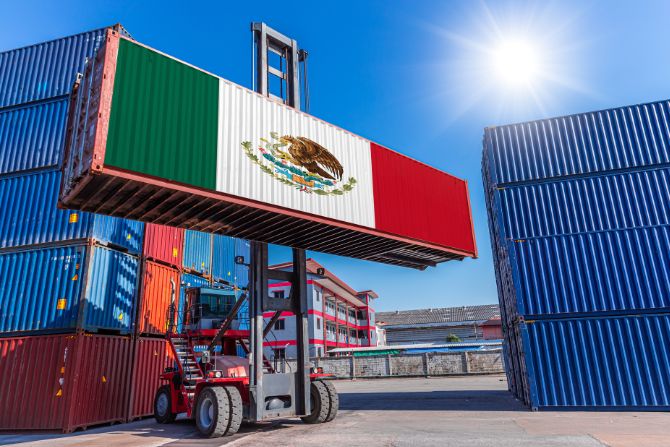
Trade between Mexico and the United States has entered a new phase.
Rules are less predictable, policy announcements can matter as much as final decisions, and logistics has shifted from a purely operational function to a strategic risk factor.
What began as sporadic tariff actions has evolved into a consistent pattern of trade pressure. As we move through 2026, tariffs are no longer isolated events but rather a recurring instrument of political and economic leverage.
In this environment, the topic of Mexico-US tariffs and logistics is no longer confined to trade specialists. It has become a critical concern for any company moving goods across the border and trying to protect margins, timelines, and customer commitments.
This article breaks down the current trade landscape and identifies which products are most exposed. It also explains why logistics strategy is now central to navigating cross-border trade between Mexico and the United States in 2026.
Table of Contents
- The New Mexico–U.S. Trade Landscape
- Key Tariff Pressures Shaping 2026
- Summary Table: Products, Rates, and Logistics Impact
- Why the Real Problem Is Not the Percentage
- The Most Common Mistake Companies Make
- Logistics as a Strategic Protection System
- The Role of the Logistics Partner in 2026
- FAQs
- Conclusion
The New Mexico–U.S. Trade Landscape
For decades, cross-border trade between Mexico and the United States was built on relative predictability. While disputes existed, changes were typically phased in and negotiated with enough lead time for companies to adapt.
That reality no longer applies.
This shift is not limited to trade between Mexico and the United States. Simultaneously, the United States has increased tariff pressure on other global partners, including Canada, as part of a broader strategy of using trade measures for geopolitical and economic leverage.
The result is a global trade environment in which supply chains face pressure from multiple directions — making logistics planning and sourcing decisions increasingly interconnected.
Today’s environment is defined by:
- sudden tariff announcements
- measures that are implemented, paused, or renegotiated within short timeframes
- entire industries facing pressure without clear timelines for resolution
The message for shippers is clear: logistics planning based on past assumptions is no longer enough.

The Mexico–U.S. trade landscape has shifted from predictable flows to constant geopolitical pressure.
Key Tariff Pressures Shaping 2026
General tariffs on imports from Mexico
- Scope: Mexican imports into the United States (broad, with USMCA exemptions).
- Effective pressure level: tariffs of up to 25% remain a viable trade tool.
- Logistics implication: only shipments that are fully USMCA-compliant can reliably avoid exposure, making documentation and rules of origin a decisive operational factor.
Even when not universally enforced, the existence of these measures reshapes purchasing strategies, inventory positioning, and contract negotiations.
Ongoing risk of tariff escalation
- Scope: Mexican imports into the United States.
- Potential escalation: tariffs reaching 30% remain on the table.
- Logistics implication: uncertainty disrupts pricing models, delays purchasing decisions, and increases demand for contingency routing and inventory buffers.
In logistics, risk begins the moment uncertainty enters the system — not when a tariff is finally paid.
Steel and aluminum
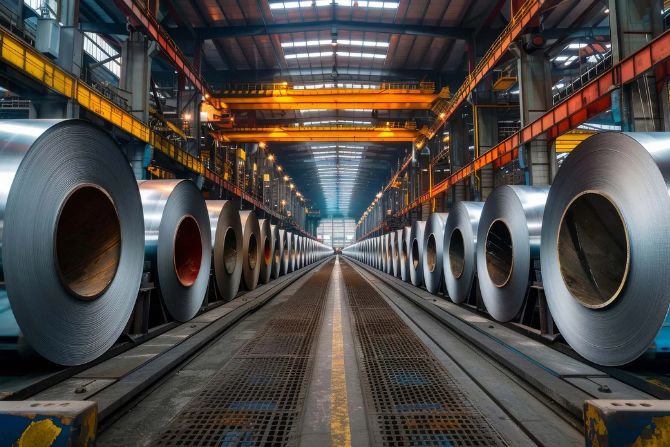
Steel and aluminum continue to reshape manufacturing logistics and supplier strategies.
According to the CFR guide to Section 232 tariffs, these measures remain a central tool in U.S. trade enforcement.
- Products: steel and aluminum, including industrial derivatives.
- Effective rate: up to 50%.
- Logistics implication: direct exposure for automotive, construction, machinery, and heavy manufacturing supply chains.
These pressures force companies to reassess supplier geography, cost structures, and cross-border routing strategies.
Mexican fresh tomatoes (antidumping duties)

Antidumping duties on Mexican tomatoes continue to create immediate pressure on margins and logistics planning.
- Product: fresh tomatoes originating in Mexico.
- Duty rate: 17.09% antidumping duty.
- Logistics implication: limited ability to absorb cost increases, forcing rapid renegotiation and tighter delivery timelines.
Summary Table: Products, Rates, and Logistics Impact
| Measure / Product | Rate / Pressure | Status in 2026 | Primary Logistics Impact |
|---|---|---|---|
| General imports from Mexico | Up to 25% | Active trade lever | Financial planning, contracts, inventory |
| Tariff escalation risk | Up to 30% | Ongoing uncertainty | Purchase delays, contingency planning |
| Steel & aluminum (Section 232) | Up to 50% | Fully enforced | Supplier and route reconfiguration |
| Mexican fresh tomatoes | 17.09% | Active antidumping duty | Margin pressure and timing risk |
Why the Real Problem Is Not the Percentage
Many companies still approach tariffs as a purely numerical issue.
In reality, there are two distinct impacts:
- Cost impact: the tariff itself.
- Uncertainty impact: announcements, reversals, negotiations, and timing risk.
The second is often far more damaging.
When a tariff issue arises while cargo is in transit, the operational and financial consequences can be difficult, or even impossible, to undo.
The Most Common Mistake Companies Make
Despite the evolving trade environment, many organizations still operate with outdated assumptions:
- choosing suppliers based solely on price,
- relying on a single transportation route,
- lacking contingency planning,
- reacting only after disruption occurs.
In 2026, this approach is increasingly fragile.
Logistics must evolve from reactive execution to anticipatory planning. As an import/export company, you need a strategic partner who can help you understand geopolitical issues, anticipate changes, and proactively shape outcomes instead of reacting to them.
Logistics as a Strategic Protection System
By 2026, the role of logistics will be fundamentally different.
It does not just move goods — it protects the business.
- tariff scenario modeling,
- alternative routing and sourcing strategies,
- continuous USMCA compliance verification,
- built-in flexibility for regulatory shifts.
Companies that treat Mexico-US tariffs logistics as a strategic discipline stop viewing logistics as a cost center and begin using it as a competitive advantage.
The Role of the Logistics Partner in 2026
In this environment, the value of a logistics partner is no longer defined by the lowest freight rate.
It is defined by the ability to provide operational certainty.
Organizations like The ILS Company support clients beyond execution — helping them anticipate regulatory changes, design resilient routing strategies, and reduce exposure before disruptions occur.
The objective is to minimize the impact of a problem before it materializes, not to react once it arises.
Resilient logistics strategies ensure continuity despite Mexico–US trade pressure.
FAQs
How do Mexico–US tariffs impact cross-border logistics?
They affect not only costs, but also routing decisions, inventory planning, compliance requirements, and delivery timelines.
Are all Mexican exports subject to these tariffs?
No. Many shipments qualify for USMCA exemptions, but enforcement of compliance requirements has become stricter.
Do tariff announcements matter even if not enforced?
Yes. Announcements alone influence purchasing behavior, contract negotiations, and logistics strategy.
Which industries are most exposed?
Manufacturing, automotive, agriculture, steel, aluminum, and fresh produce remain the most exposed.
Conclusion
Trade pressure between Mexico and the United States is no longer a temporary disruption. It is now a permanent operating condition.
In 2026, success will not come from moving faster or cheaper, but from moving with foresight, clarity, and control.
Understanding the logistics of Mexico-U.S. tariffs is now essential for companies that want to protect their margins, maintain operational stability, and remain competitive in an increasingly volatile trade environment.
In a world where trade rules can shift without warning, the difference between resilience and disruption often comes down to how deliberately the logistics strategy was designed from the start.